Connectez-vous/S’inscrire
Votre e-mail a été envoyé.

2501 Rose Walk Immeuble residentiel 9 lots 5 162 055 € (573 562 €/Lot) Berkeley, CA 94708
Certaines informations ont été traduites automatiquement.
Informations principales sur l'investissement
- Property of rare architectural distinction: designed by Henry H. Gutterson as part of one of the first planned urban developments
- City Landmark status plus a Mills Act Agreement offers substantial property tax advantages!
- Designed to compliment Bernard Maybeck's Rose Walk path, connecting the hills to central Berkeley
- Each unit is separately metered, with tenants paying for their own gas and electricity
Résumé analytique
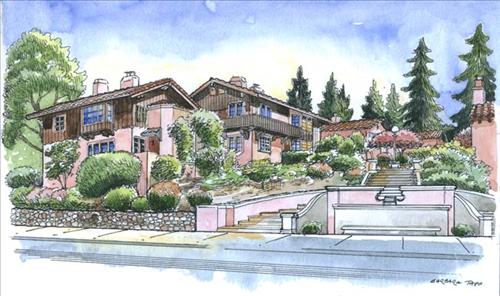
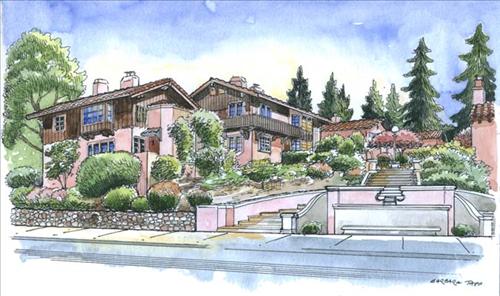
Welcome to a property of rare architectural heritage, unparalleled historic provenance, and civic beauty. Welcome to The Rose Walk Complex in North Berkeley. If you are a local you may well have seen the impressive pink concrete bench on Euclid Avenue, noticed the landmark plaque, or wandered up the curving stairs to find yourself at one of Berkeley’s hidden architectural treasures, and wondered about these handsome buildings.
They were designed, beginning in 1924, by Henry Higby Gutterson, a graduate of the first year of UC Berkeley’s architecture school as well as the Ecole des Beaux Arts in Paris. Gutterson worked in consultation with renowned architect Bernard Maybeck, who had already designed the Rose Walk itself in 1913. Maybeck was said to have approved of the design, proportion and scale of these buildings as it complemented the Walk, considered a high point of his urban designs.
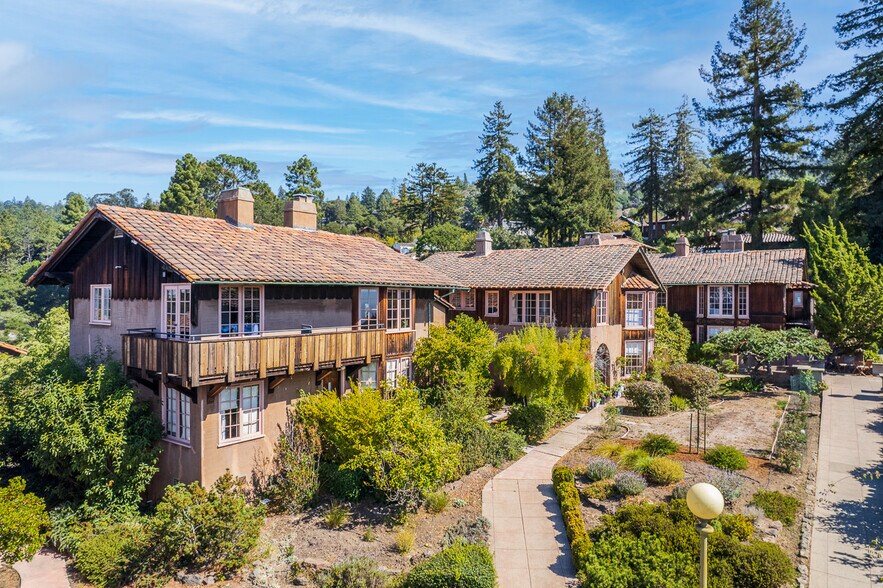
This impressive complex is composed of four duplexes and one cottage, a total of nine units on one parcel to the north of the walk that occupies over 9000 sq. T of interior space on a lot of 20,000 sq T. These five structures were designed as part of an integrated urban community of single and multi-family residences bordering a pedestrian path, and quoting Maybeck: facing "an immense garden with nothing to show that it is not all one, owned by each."
The complex was designed as a model for housing in a high-density urban area. And when completed it was considered a triumph of urban planning, and one of the most artistic urban developments in the country.
Rose Walk itself is a hidden Berkeley treasure, inaccessible by cars, but beloved by all, especially hikers and dog walkers, who have discovered it as part of an exceptional series of paths to enjoy the beauty of North Berkeley. Rose Walk is undoubtedly one of the grandest of Berkeley's pedestrian pathways, constructed to easily link areas in the hills to the central areas by means of shortcuts. These paths would play an important role as emergency exits in event of fire, such as was experienced in North Berkeley in September 1923, an event which destroyed nearly 600 homes, including 19 residences designed by Maybeck, including his own home.
Maybeck completed Rose Walk with the financial support of its adjoining neighbors. The property on either side was purchased by Florence Dickens Gray and her husband Dr. B. Frank Gray after the 1923 fire, and the walk was deeded to the City of Berkeley in 1924, the same year that the first structure of the complex was completed. That was cottage on Codornices Road. As the Grays had available resources, they continued to add duplexes until the entire complex was completed in 1936.
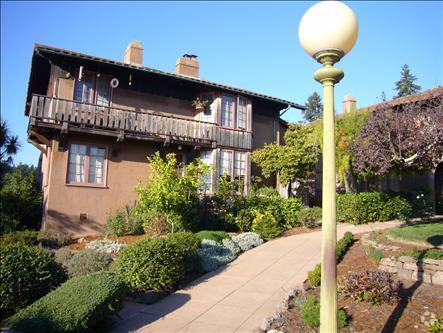
The four duplexes are nestled along a lush garden of California natives, succulents, citrus trees and roses, that borders Rose Walk. Each duplex contains two single-floor units used as two+ bedroom, one bath residences. Each duplex is unique in design, and set apart from the others so as not to encroach on views. These handsome structures are distinctive for their integrated-color stucco, vertical wood siding, salmon colored trim and original flat Ele roofs. Upper units all have lovely views of the Bay and beyond, and their stairwells provide an additional sense of spaciousness; those units tend to have greater demand as a result. Some enjoy private balconies or decks.
We are fortunate that one unit has been kept vacant purposely, so that agents and prospective buyers can experience firsthand the beauty of these residences. While unique, all units enjoy hardwood floors, fireplaces, wooden windows with vintage custom hardware and individual architectural details. The units within the duplexes were built to have both a bedroom and a formal dining room with a closet, and those are now used as two-bedroom units. Most of the units also include sun porches that make ideal offices. Many of the kitchens have been tastefully updated. And this vacant unit is unique in having its own laundry hookups. This unit most recently rented for the market rate of $4200/month.
Residents of the other units are able to use the common laundry room located in this back duplex off Codornices Road. which generates additional income
The cottage, the original structure of the complex, has the rustic charm of all-redwood interior and exterior, set in a redwood grove, and enjoys private use of a spacious redwood deck with carved railings, that sits atop a three-bay garage. The complex has a total of nine garages, all located along Codornices Road. Most of the garages are rented as a separate source of income.
Each unit is separately metered, with tenants paying for their own gas and electricity.
The complex was gifted to the University in 1990 as housing for faculty,
and designated a Berkeley Landmark in 1991. It now enjoys the remarkable tax advantages of a Mills Act Agreement for the preservation of historic properties. It is ideal for buyers with vision! Experience pride of ownership now, with many options for upside in revenue, and future enjoyment of this one-of-a-kind treasure.
Residents enjoy the ultimate location for urban living: located within blocks of UC Berkeley and just one block from the beautiful Berkeley Rose Garden and Codornices Park across the road; buses stop in front of this complex and easily make connections to the campus, downtown Berkeley, and from the BART station to anywhere in the Bay Area.
They were designed, beginning in 1924, by Henry Higby Gutterson, a graduate of the first year of UC Berkeley’s architecture school as well as the Ecole des Beaux Arts in Paris. Gutterson worked in consultation with renowned architect Bernard Maybeck, who had already designed the Rose Walk itself in 1913. Maybeck was said to have approved of the design, proportion and scale of these buildings as it complemented the Walk, considered a high point of his urban designs.
This impressive complex is composed of four duplexes and one cottage, a total of nine units on one parcel to the north of the walk that occupies over 9000 sq. T of interior space on a lot of 20,000 sq T. These five structures were designed as part of an integrated urban community of single and multi-family residences bordering a pedestrian path, and quoting Maybeck: facing "an immense garden with nothing to show that it is not all one, owned by each."
The complex was designed as a model for housing in a high-density urban area. And when completed it was considered a triumph of urban planning, and one of the most artistic urban developments in the country.
Rose Walk itself is a hidden Berkeley treasure, inaccessible by cars, but beloved by all, especially hikers and dog walkers, who have discovered it as part of an exceptional series of paths to enjoy the beauty of North Berkeley. Rose Walk is undoubtedly one of the grandest of Berkeley's pedestrian pathways, constructed to easily link areas in the hills to the central areas by means of shortcuts. These paths would play an important role as emergency exits in event of fire, such as was experienced in North Berkeley in September 1923, an event which destroyed nearly 600 homes, including 19 residences designed by Maybeck, including his own home.
Maybeck completed Rose Walk with the financial support of its adjoining neighbors. The property on either side was purchased by Florence Dickens Gray and her husband Dr. B. Frank Gray after the 1923 fire, and the walk was deeded to the City of Berkeley in 1924, the same year that the first structure of the complex was completed. That was cottage on Codornices Road. As the Grays had available resources, they continued to add duplexes until the entire complex was completed in 1936.
The four duplexes are nestled along a lush garden of California natives, succulents, citrus trees and roses, that borders Rose Walk. Each duplex contains two single-floor units used as two+ bedroom, one bath residences. Each duplex is unique in design, and set apart from the others so as not to encroach on views. These handsome structures are distinctive for their integrated-color stucco, vertical wood siding, salmon colored trim and original flat Ele roofs. Upper units all have lovely views of the Bay and beyond, and their stairwells provide an additional sense of spaciousness; those units tend to have greater demand as a result. Some enjoy private balconies or decks.
We are fortunate that one unit has been kept vacant purposely, so that agents and prospective buyers can experience firsthand the beauty of these residences. While unique, all units enjoy hardwood floors, fireplaces, wooden windows with vintage custom hardware and individual architectural details. The units within the duplexes were built to have both a bedroom and a formal dining room with a closet, and those are now used as two-bedroom units. Most of the units also include sun porches that make ideal offices. Many of the kitchens have been tastefully updated. And this vacant unit is unique in having its own laundry hookups. This unit most recently rented for the market rate of $4200/month.
Residents of the other units are able to use the common laundry room located in this back duplex off Codornices Road. which generates additional income
The cottage, the original structure of the complex, has the rustic charm of all-redwood interior and exterior, set in a redwood grove, and enjoys private use of a spacious redwood deck with carved railings, that sits atop a three-bay garage. The complex has a total of nine garages, all located along Codornices Road. Most of the garages are rented as a separate source of income.
Each unit is separately metered, with tenants paying for their own gas and electricity.
The complex was gifted to the University in 1990 as housing for faculty,
and designated a Berkeley Landmark in 1991. It now enjoys the remarkable tax advantages of a Mills Act Agreement for the preservation of historic properties. It is ideal for buyers with vision! Experience pride of ownership now, with many options for upside in revenue, and future enjoyment of this one-of-a-kind treasure.
Residents enjoy the ultimate location for urban living: located within blocks of UC Berkeley and just one block from the beautiful Berkeley Rose Garden and Codornices Park across the road; buses stop in front of this complex and easily make connections to the campus, downtown Berkeley, and from the BART station to anywhere in the Bay Area.
Informations sur l’immeuble
| Prix | 5 162 055 € | Classe d’immeuble | C |
| Prix par lot | 573 562 € | Surface du lot | 0,15 ha |
| Type de vente | Investissement | Surface de l’immeuble | 889 m² |
| Condition de vente | 1031 Exchange | Occupation moyenne | 100% |
| Nb de lots | 9 | Nb d’étages | 2 |
| Type de bien | Immeuble residentiel | Année de construction | 1925 |
| Sous-type de bien | Appartement | Ratio de stationnement | 0,09/1 000 m² |
| Style d’appartement | Avec jardin |
| Prix | 5 162 055 € |
| Prix par lot | 573 562 € |
| Type de vente | Investissement |
| Condition de vente | 1031 Exchange |
| Nb de lots | 9 |
| Type de bien | Immeuble residentiel |
| Sous-type de bien | Appartement |
| Style d’appartement | Avec jardin |
| Classe d’immeuble | C |
| Surface du lot | 0,15 ha |
| Surface de l’immeuble | 889 m² |
| Occupation moyenne | 100% |
| Nb d’étages | 2 |
| Année de construction | 1925 |
| Ratio de stationnement | 0,09/1 000 m² |
Caractéristiques
- Détecteur de fumée
Caractéristiques du lot
- Cheminée
- Cuisine
- Planchers en bois
- Réfrigérateur
- Cuisinière
- Avec jardin
Caractéristiques du site
- Laverie
Lot informations sur la combinaison
| Description | Nb de lots | Moy. loyer/mois | m² |
|---|---|---|---|
| Studios | 1 | - | 58 |
| 1+1 | 8 | 3 616 € | 97 - 118 |
1 1
Moyennement praticable à pied
60/100
Moyennement adapté aux voitures
70/100
Transports en commun relativement accessibles
50/100
Moyennement praticable en vélo
60/100
Taxes foncières
| Numéro de parcelle | 060-2468-007-02 | Évaluation des aménagements | 1 554 902 € |
| Évaluation du terrain | 666 374 € | Évaluation totale | 2 221 277 € |
Taxes foncières
Numéro de parcelle
060-2468-007-02
Évaluation du terrain
666 374 €
Évaluation des aménagements
1 554 902 €
Évaluation totale
2 221 277 €

1 sur 14
Vidéos
Visite extérieure 3D Matterport
Visite 3D
Photos
Street view
Rue
Carte
1 sur 1


Présenté par
2501 Rose Walk
Vous êtes déjà membre ? Connectez-vous
Hum, une erreur s’est produite lors de l’envoi de votre message. Veuillez réessayer.
Merci ! Votre message a été envoyé.